 Skip to main content


A customer called us recently, confused about what size air cleaner to buy for her bedroom. She is far from alone. Choosing a make is hard enough, and then you have to pick a model. Manufacturers add to the confusion with square footage ratings and CADR numbers that don't always tell you what you need to know.
The good news is that sizing an air cleaner comes down to one simple calculation. Once you know it, you can check any machine against any room in about a minute.
Why Square Footage Isn't Enough
We live in three dimensions. An air cleaner doesn't clean floor space; it cleans the air above the floor, all the way up to the ceiling. Two rooms with the same square footage can hold very different amounts of air. A 12 x 14 bedroom with 8-foot ceilings holds 1,344 cubic feet of air. The same bedroom with 12-foot ceilings holds 2,016, which is 50% more air to clean.
That's why the number that matters is the room's volume, measured in cubic feet.
How to Size an Air Cleaner in Three Steps
Step 1: Find the room's volume. Remember volume from geometry class? Multiply length by width by ceiling height, all in feet.
Room volume (cubic feet) = length x width x ceiling height
Step 2: Find the machine's airflow. Look in the technical specifications for a number followed by "CFM," which stands for cubic feet per minute. That is how much air the motor moves through the filter every minute. Most machines list a different CFM for each fan speed, so note all of them, not just the highest.
Step 3: Calculate air changes per hour. Air changes per hour (ACH) tells you how many times an hour the machine pulls all of the air in the room through its filter.
Air changes per hour = (CFM x 60) / room volume
Then compare the result to this target:
- 5 air changes per hour is the minimum we recommend. It matches the CDC's target of at least 5 air changes per hour of clean air in occupied spaces.
- 10 or more is what we like to see, especially for allergies, asthma, or a bedroom you sleep in every night. More is better.
Tip: Run the calculation for the fan speed you'll actually use, not just high. Most people run their air cleaner on a lower, quieter speed most of the time, especially overnight.
Worked Example: A 12 x 14 Master Bedroom
Let's size an air cleaner for a 12 x 14 master bedroom with 10-foot ceilings.
Room volume: 12 x 14 x 10 = 1,680 cubic feet
We'll compare two popular models. The Austin Air HealthMate HM400 moves 75, 200, or 400 CFM depending on fan speed. The smaller HealthMate Junior HM200 moves 50, 100, or 200 CFM.
| Fan speed | HealthMate HM400 | HealthMate Junior HM200 |
|---|---|---|
| Speed 3 (high) | 400 CFM = 14.3 air changes/hr | 200 CFM = 7.1 air changes/hr |
| Speed 2 (medium) | 200 CFM = 7.1 air changes/hr | 100 CFM = 3.6 air changes/hr |
| Speed 1 (low) | 75 CFM = 2.7 air changes/hr | 50 CFM = 1.8 air changes/hr |
Here's the math for the HM400 on high: 400 CFM x 60 = 24,000 cubic feet per hour. Divide by 1,680 cubic feet, and you get 14.3 air changes per hour. Put another way, it moves all of the room's air through the filter about every 4 minutes.
The verdict: The HM400 is a great fit. It clears 10 air changes per hour on high and still beats the 5-per-hour minimum on medium, a quieter speed you can live with day to day. The Junior meets the minimum only on high and falls short on medium, so in this room it would have to run at full speed all the time.
What happens with taller ceilings?
Now raise the ceiling in the same room to 12 feet.
Room volume: 12 x 14 x 12 = 2,016 cubic feet
- HM400 on high (400 CFM): 11.9 air changes per hour. On medium (200 CFM), it drops to 6.0. It can still do the job.
- Junior on high (200 CFM): 6.0 air changes per hour. That's right at the edge, with no room to turn it down.
Adding two feet of ceiling cut performance by about 17% for both machines. The floor didn't change at all.
And with standard 8-foot ceilings?
For comparison, the same 12 x 14 room with 8-foot ceilings holds 1,344 cubic feet. There, the Junior gives 8.9 air changes per hour on high, and the HM400 gives 8.9 on medium. Either one could work, and the HM400 gives you more headroom.
Quick Chart: How Much CFM Your Room Needs
If you'd rather skip the math, find your room below. The chart shows the CFM needed for 5 air changes per hour. For 10 air changes per hour, double the number. Then check that the air cleaner reaches that CFM on a speed you're comfortable running.
| Room size | 8-ft ceiling | 9-ft ceiling | 10-ft ceiling |
|---|---|---|---|
| 10 x 12 ft (120 sq ft) | 80 CFM | 90 CFM | 100 CFM |
| 12 x 14 ft (168 sq ft) | 112 CFM | 126 CFM | 140 CFM |
| 14 x 16 ft (224 sq ft) | 150 CFM | 168 CFM | 187 CFM |
| 16 x 20 ft (320 sq ft) | 214 CFM | 240 CFM | 267 CFM |
| 20 x 24 ft (480 sq ft) | 320 CFM | 360 CFM | 400 CFM |
The chart works backward from the same formula: CFM needed = room volume x air changes per hour / 60.
What "Covers Up to 700 Square Feet" Really Means
If you only looked at the box, you might think a HealthMate Junior would be more than enough for a 12 x 14 bedroom. After all, that room is only 168 square feet, and the Junior is rated for spaces up to 700 square feet.
Here is the catch. Run the numbers on 700 square feet with 8-foot ceilings, and you get 5,600 cubic feet of air. At 200 CFM on high, the Junior would change that air only about 2 times an hour. That's well under the 5 we recommend as a minimum.
Coverage ratings aren't necessarily wrong. They're often based on a lower air-change rate than you probably want for allergies or asthma, and they usually assume the machine is on high. Treat the square footage on the box as a maximum, not a recommendation, and do your own air-change math.
What about CADR?
CADR (Clean Air Delivery Rate) is a standardized rating of how much filtered air a unit delivers at its highest speed, measured in cubic feet per minute. It's listed separately for smoke, dust, and pollen. You can plug a CADR number into the same air-change formula in place of CFM. If a unit lists both, use the lower number to be safe. And if you're after the smallest particles, the EPA suggests going by the smoke CADR.
Tips for Getting the Size Right
- If you're between sizes, go up. A bigger machine running on a quiet medium speed usually beats a smaller one straining on high.
- Measure the whole open space. If your living room opens onto a kitchen and dining area with no doors between them, measure the entire connected area. The air moves freely between them, and so does whatever's in it.
- Close the door for a single room. In a bedroom, keeping the door closed lets the machine concentrate on the air you're breathing.
- Give it room to breathe. Keep the intake and outlet clear of furniture, curtains, and walls. A unit tucked in a corner or behind a chair won't perform to its rating.
- Remember these are best-case numbers. The formula assumes the room's air mixes well. Furniture, closed-off corners, and poor placement all lower real-world results, which is another reason to aim above the minimum.
- Check the noise at each speed. A machine that hits your target only on a loud setting will end up turned off. Look for a decibel rating at the speed you plan to use.
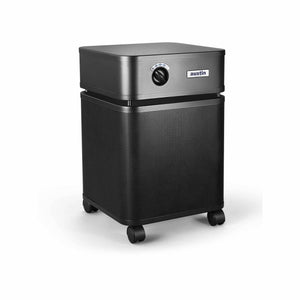
Austin Air HealthMate HM400 Air Cleaner
Our pick for master bedrooms, living rooms, and rooms with tall ceilings. True medical grade HEPA with activated carbon and zeolite, three fan speeds (75, 200, and 400 CFM), and a filter rated to last 5 years.
Shop Austin Air HM400
Austin Air HealthMate Junior HM200 Air Cleaner
A compact version of the HealthMate for smaller bedrooms, nurseries, home offices, and dorm rooms with standard ceilings. Same four-stage filtration in a smaller unit, with three fan speeds (50, 100, and 200 CFM).
Shop Austin Air HM200Frequently Asked Questions
What size air purifier do I need for my room?
Multiply your room's length, width, and ceiling height to get its volume in cubic feet. Then multiply the air purifier's CFM by 60 and divide by the room volume. That gives you air changes per hour. Aim for at least 5, and 10 or more if you have allergies or asthma.
How many air changes per hour do I need?
At least 5, which matches the CDC's target for clean air in occupied spaces. For allergies, asthma, or a bedroom, we recommend 10 or more when the room and budget allow.
Why does ceiling height matter?
An air cleaner cleans the air in the whole room, not just the floor area. A room with 12-foot ceilings holds 50% more air than the same room with 8-foot ceilings, so it needs 50% more airflow to reach the same number of air changes per hour.
Can I trust the square footage rating on the box?
Treat it as a maximum. Coverage ratings are often based on fewer air changes per hour than you likely want for allergies, and they usually assume the machine runs on high. Do the air-change calculation for your own room to be sure.
Is it better to buy a bigger air purifier than I need?
Usually, yes. A larger machine can reach your target on a lower, quieter speed, and it gives you extra capacity for bad allergy days, cleaning, or wildfire smoke.
The Bottom Line
When picking any air cleaner, remember that we live in three dimensions. Calculate the room's volume, check the machine's CFM at the speed you'll actually use, and make sure you're getting at least 5 air changes per hour, and ideally 10 or more. If you need help figuring it out, just give us a call.
Til next time,
Cheryl
Want us to run the numbers for you?
Send us your room's length, width, and ceiling height, and we'll recommend the right size air cleaner for your space.
Shop air purifiersPrefer to talk it through? Call us at (800) 771-2246.
Additional reading
- How to Choose a HEPA Air Cleaner
- Air purifier buying guide for allergies and asthma
- Best Air Purifier for Dust Mite Allergies
Sources
Centers for Disease Control and Prevention. Improving Ventilation in Buildings.
U.S. Environmental Protection Agency. Air Cleaners and Air Filters in the Home.
Austin Air product specifications for the HealthMate HM400 and HealthMate Junior HM200.
Want the complete picture? This page is part of our free Practical Guide to Allergy-Free Living, which draws on decades of allergy expertise and covers dust mites, pet dander, air quality, laundry, and more.