 Skip to main content


One question we hear a lot from first-time buyers: do you need tape over the zipper on a dust mite-proof mattress cover? It's a reasonable thing to wonder, especially if you've seen tape recommended for a different kind of cover.
Short answer: no, it's not necessary. If it makes you feel better, it won't hurt anything, as long as you use an easily removable tape. Skip the duct tape. Here's the biology behind that answer, and when tape actually does matter.
How Dust Mites Actually Get Into the Air
Some people picture dust mites as highly mobile, crawling around in search of a host. That is not how they behave. Dust mites avoid light and live deep inside soft material like pillows, mattresses, and carpet, where humidity stays higher. A published practice parameter on dust mite exposure control describes their full life cycle, egg to adult, as taking roughly 60 to 120 days depending on temperature and humidity, with adults living about 4 to 6 weeks.
What actually causes an allergic reaction is airborne exposure, not the mite itself touching you. Dust mite allergen lives in their feces and body parts. When bedding or carpet is disturbed, those particles become airborne, and that same research describes them settling back out within roughly 15 to 30 minutes. Making the bed, or simply moving around on it while you sleep, sends a cloud of those particles into the air, and breathing that in is what triggers symptoms.
Dust mites do not crawl out of your mattress at night and move around on your body, and they do not crawl up your nose or down your throat. If an item were never disturbed, the allergen inside it would stay put.
How a Zippered Cover Stops That
A dust mite-proof zippered cover works by containing the mites, their allergen, and any dust that gets stirred up, inside a tightly woven barrier. When the mattress or pillow is disturbed, the particles that become airborne stay inside the cover rather than reaching the air you breathe. Dust mites are not seeking a way out, so a closed zipper is enough; there is no mite trying to squeeze through the teeth.
Bed Bugs Are a Different Story
If your zippered cover is meant to deal with bed bugs, the calculation changes. The EPA recommends mattress, box spring, and pillow encasements as part of bed bug control, specifically to trap bugs and help you spot an infestation. Unlike dust mites, bed bugs are mobile and actively search for ways out.
Because of that, a bed bug encasement needs a different kind of zipper. According to pest-control guidance on bed bug encasements, the zipper needs very small, closely spaced teeth, and it has to seal completely with no gaps, since immature bed bugs can be small enough to work their way between teeth that aren't tight enough. The end of the zipper, where the two sides meet, is often the weak point.
Tip: That is exactly why our bed bug covers are built differently from our dust mite covers. Our zippered bed bug covers include a patented tape seal over the zipper end, the spot most likely to let a bug through, plus a protective flap over the zipper itself.
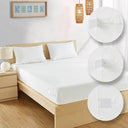 |
AllergyCare Bed Bug-Proof Mattress Cover A certified escape-proof zipper system, an internal protective flap, and a patented tape seal over the zipper end built specifically to stop bed bugs, not just dust mites. Shop bed bug covers |
If You Still Want to Tape It
Now that you know how dust mite particles actually spread, taping the zipper on a dust mite cover is not going to add real protection. But if it helps you feel more confident, it won't hurt anything, with one condition.
Safety note: Use an easily removable tape, such as blue painter's tape, available at any hardware store. Do not use duct tape or masking tape. Their adhesive can stick to the zipper and gum it up, making it difficult or impossible to open.
That matters for your warranty, too. All of our zippered covers are warranted against manufacturing defects, but a zipper gummed up by tape residue is not a manufacturing defect, so it would not be covered.
Frequently Asked Questions
Do I need tape over the zipper on a dust mite cover?
No. Dust mites are not mobile and are not trying to escape through the zipper, so a closed zipper on its own keeps the allergens contained. Tape is optional and only for peace of mind.
How long do dust mites live, and how far do they travel?
Published research describes their full life cycle as taking roughly 60 to 120 days, with adults living about 4 to 6 weeks. They avoid light and stay embedded in soft materials like mattresses, pillows, and carpet rather than traveling or searching for a host.
If tape is not necessary for dust mites, why do bed bug covers need it?
Because bed bugs behave very differently. They are mobile and actively search for a way out, and immature bed bugs can be small enough to squeeze through a zipper that is not sealed tightly, especially at the end where the zipper closes. That is why bed bug covers use smaller, closer-set teeth and an added seal at that end point.
What kind of tape is safe to use if I want extra peace of mind?
An easily removable tape, such as blue painter's tape. Avoid duct tape and masking tape, since their adhesive can gum up the zipper and make it hard to open, which is not covered under a manufacturer's warranty.
The Bottom Line
A dust mite cover works by containing allergens, not by fighting off an invader trying to escape, so the zipper alone does the job. Tape is a nice-to-have at most, and the wrong kind of tape can cause a problem of its own. Bed bugs are the exception, where a sealed zipper end genuinely matters.
Shopping for allergy-proof bedding?
We've been helping people with allergies and asthma find the right covers since 1989.
Shop mattress coversPrefer to talk it through? Call us at (800) 771-2246.
Sources
Portnoy J, et al. (2013). Environmental assessment and exposure control of dust mites: a practice parameter. Annals of Allergy, Asthma & Immunology, via PubMed Central.
U.S. Environmental Protection Agency. Controlling Bed Bugs Using Integrated Pest Management (IPM).
Alaska Department of Environmental Conservation. Mattress Encasements for Bed Bugs.
Medical disclaimer: This content is for educational and informational purposes only and is not intended as medical advice. Always consult a qualified healthcare provider regarding allergies, asthma, or other medical conditions.
Want the complete picture? This page is part of our free Practical Guide to Allergy-Free Living, which draws on decades of allergy expertise and covers dust mites, pet dander, air quality, laundry, and more. Start at the beginning or jump to the section that matters most to you.