 Skip to main content


You've cleaned, vacuumed, and washed everything in sight. The apartment sat empty for weeks. Surely any bed bugs have starved by now, right?
Unfortunately, bed bugs are far more patient than most of us expect. That's frustrating, but knowing how long bed bugs live helps you plan a treatment that actually works. Here's what the CDC and EPA say.
How Long Do Bed Bugs Live?
Adult bed bugs usually live 6 to 12 months, according to the CDC's bed bug life cycle page. The EPA gives the same range and notes that some live longer.
How long an individual bug lasts depends on how often it can feed and on the temperature around it. The EPA says bed bugs stay active at temperatures as low as 46°F, so a cool room won't stop them.
How Long Can Bed Bugs Live Without Feeding?
This is the number that surprises people. The EPA says bed bugs typically feed every 5 to 10 days, but they can survive several months to a year without a blood meal.
The CDC agrees that bed bugs can live several months without a blood meal. So an apartment that has sat empty for a few weeks can still have bed bugs, and leaving home for a while won't starve them out.
The Bed Bug Life Cycle
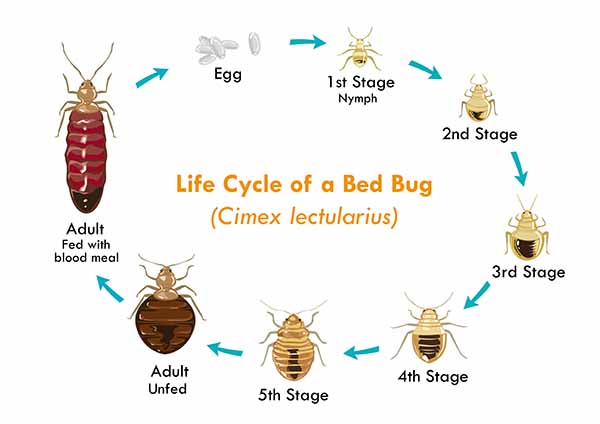
A bed bug goes through several stages on its way to adulthood. The EPA's life cycle guide lists them with approximate sizes:
- Egg (about 1 mm): pearl-white and about the size of a pinhead. The CDC says eggs hatch in about 4 to 12 days.
- Five nymph stages (about 1.5 mm to 4.5 mm): nymphs are young bed bugs that look like smaller, paler adults. Each one needs a blood meal before it can molt, or shed its skin, and move to the next stage.
- Adult (about 5 to 7 mm): roughly the size of an apple seed.
Those shed skins are one of the signs to look for when you check a mattress. Learn what else to look for in What Are Bed Bugs? How to Identify Them and Why They Spread.
How Fast Do Bed Bugs Multiply?
According to the EPA, one female may lay 1 to 3 eggs a day and 200 to 500 eggs over her lifetime. Under favorable conditions, the full cycle from egg to egg-laying adult can take just four to five weeks.
To keep mating and laying eggs, both males and females need to feed at least once every 14 days. In other words, a few bugs can become many in a couple of months, which is why catching them early matters so much.
What This Means for Getting Rid of Them
Bed bugs' long life and patience shape every step of a good treatment plan. The EPA's do-it-yourself guide builds that timing right in:
- Keep mattress encasements on for a year. The EPA recommends a cover that's been tested for bed bugs and is strong enough to last a full year without tearing. Any bugs sealed inside can't feed and eventually die.
- Seal up items you can't treat. The EPA says to keep them in a sealed plastic bag or container for up to a year.
- Keep checking for a year. Inspect at least every 7 days after treatment, in case eggs hatch, and keep watching for at least a year.
Heat helps too. The EPA says bed bugs die when their body temperature reaches 113°F, but the space around them has to be even hotter for the heat to reach every hiding spot. That's why a clothes dryer on high heat works for bedding and clothes, while whole-room heat treatment is a job for professionals. For the full step-by-step plan, see How to Get Rid of Bed Bugs in a Mattress.
Choosing a Cover That Lasts the Year
Because the encasement has to hold up for 12 months or more, the fabric and zipper both matter. We recommend AllergyCare Stretch Knit (BedBug Solution Elite) covers for both active infestations and prevention. The polyester knit is fused to a urethane membrane, so it's bed bug proof and blocks dust mite allergens too.
Wondering why a regular dust mite cover isn't enough? We explain in Are Dust Mite Proof Covers Bed Bug Proof?
Frequently Asked Questions
How long do bed bugs live?
Adult bed bugs usually live 6 to 12 months, according to the CDC and EPA, and sometimes longer.
How long can bed bugs live without feeding?
The EPA says bed bugs typically feed every 5 to 10 days but can survive several months to a year without a blood meal.
How fast do bed bugs multiply?
Per the EPA, a female may lay 1 to 3 eggs a day and 200 to 500 eggs in her lifetime. Under favorable conditions, the egg-to-egg life cycle can take four to five weeks.
How long should I keep a bed bug mattress encasement on?
The EPA recommends leaving encasements on for a year, and choosing one tested for bed bugs that's strong enough to last that long without tearing.
What temperature kills bed bugs?
The EPA says bed bugs die when their body temperature reaches 113°F. The surrounding space has to be even hotter so the heat reaches bugs wherever they hide, which is why professional heat treatment uses special equipment.
Patience Wins
Bed bugs are patient, but you can be more patient. Seal the bed, keep checking, and give the plan a full year. Questions about sizing a cover? Call us at (800) 771-2246. We've helped people with allergies since 1989, and we're glad to help with bed bugs too.
Want the complete picture? This post is part of our free Practical Guide to Allergy-Free Living, built on allergy expertise we've been sharing since 1989 and covering dust mites, pet dander, air quality, laundry, and more.
Sources
- CDC, DPDx: Bed Bugs (life cycle): https://www.cdc.gov/dpdx/bedbugs/index.html
- CDC, About Bed Bugs: https://www.cdc.gov/bed-bugs/about/index.html
- U.S. EPA, Bed Bugs Appearance and Life Cycle: https://www.epa.gov/bedbugs/bed-bugs-appearance-and-life-cycle
- U.S. EPA, How to Find Bed Bugs: https://www.epa.gov/bedbugs/how-find-bed-bugs
- U.S. EPA, Protecting Your Home from Bed Bugs: https://www.epa.gov/bedbugs/protecting-your-home-bed-bugs
- U.S. EPA, Do-it-yourself Bed Bug Control: https://www.epa.gov/bedbugs/do-it-yourself-bed-bug-control
- U.S. EPA, Top Ten Tips to Prevent or Control Bed Bugs: https://www.epa.gov/bedbugs/top-ten-tips-prevent-or-control-bed-bugs
Medical Disclaimer: The information on this page is for educational purposes only and is not a substitute for professional medical advice, diagnosis, or treatment. Always consult a qualified healthcare provider — such as an allergist or your primary care physician — before making changes to your allergy management plan, starting new treatments, or if you have questions about a medical condition. In the event of a severe allergic reaction or anaphylaxis, call 911 or your local emergency number immediately and use an epinephrine auto-injector if one has been prescribed.